
Backdoor Supplementation?
Growers Mineral, Corp.'s experience with alfalfa and other forages is to allow the crop a fairly wide window of absorption time in order for the plant to utilize foliar applied nutrition (elements). Therefore, foliar recommendations for forages are to apply the foliar nutrition a few days after cutting when the new leaf growth has appeared to start absorbing the foliar application. Once the elements are absorbed, the plant utilizes those elements in their growth processes. So, when a producer sprayed GMS one evening and cut the forage 12 hours later, the Growers Research Project Team test of a forage cut that quickly.
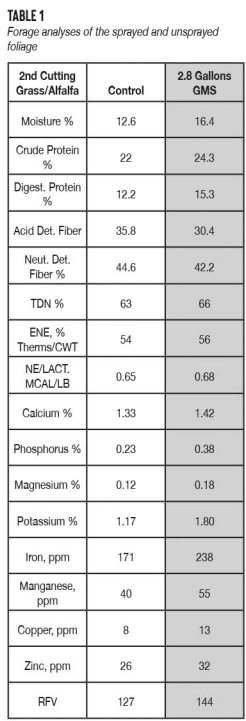
The results in Table 1 are from a second cutting alfalfa/grass hay from a GMS dairy farmer on the program for at least 20 years with GMS regularly applied to all crops. The GMS was applied at 2.8 gallons per acre at nightfall and then the hay cut 12 hours later, wrapped and samples pulled. The control sample was taken from a portion of the field that was not sprayed with GMS.
The 2.8 gallons of GMS was the first time this year that GMS had been applied to this field. The first statement from the farmer after viewing the test was the increase in protein alone would easily cover the cost of the GMS and application costs.
The ADF and NDF figures seem to indicate a rapid assembly of new growth which is further supported by the relative feed value increase. The value of the increase of the rest of the minerals in the sample would be in a much more bio-available form than anything that could possibly be bought and supplemented!
Repeat tests are being planned for the forthcoming year. Many thoughts arise when studying this and it is fun to listen to what first strikes a reader after an overview of this test. Let the conversation begin!
The final interesting observation to consider from Table 1 is the change in TDN (Total Digestible Nutrients) and NE/LACT (Net Energy for Lactation). These two measurements attempt to measure the amount of energy that is trapped by the forage. The energy within the plant results from the plant's ability to trap energy from the sun through the process of photosynthesis. If these tests are truly correct and the sprayed plants have accumulated more energy (sugar), how did that occur since the GMS was applied just before the plant went into a period (night) with no access to the energy needed for the process of photosynthesis? So, how did the applied foliar elements allow the plant to form more energy (sugar) within its structure? Was the early morning sunshine enough to increase TDN by 4.76%? As we mentioned previously, it is probably a good idea for the Growers Research Team to run more tests to see how the GMS foliar sprays affect crop quality as well as crop yield.
This is an excerpt from the Winter Growers Solution (2021) written by Growers Research Team.
Signup for our newsletter to stay in the loop
