What’s In Fertilizer?
Another Growers Mineral, Corp. research project was designed to compare the solubility of dry fertilizer to Growers Mineral Solutions (GMS). The design of the test was set to show how long it would take dry fertilizer to totally dissolve in a clean reverse osmosis (RO) water source.
A given weight of fertilizer was added to a given volume of RO water and was stirred on an automatic stirring device which made use of a magnetic pill to create the stirring action. After a given amount of time stirring, the mixture was allowed to sit without stirring to allow undissolved material to settle to the bottom of the mixture. The liquid of the mixture was removed and fresh water was added to the material that did not dissolve in the original water and was again stirred for a given amount of time with the automatic stirring apparatus. This procedure was followed for eight rinsings. At the end of eight rinsings, the remaining undissolved material was dried and weighed. Of the original dry fertilizer used, 25% was not solubilized with the eight RO water rinsings. The lack of dry fertilizer solubility is not news to many farmers (remember that the plant has to absorb elements dissolved in water because no element is ever absorbed in dry form).
Many agricultural producers suggest that the low cost of certain fertilizer products allows the application of more product to the environment to assure enough fertility is present for the current crop, plus for future crops. "Build-up is the term that is used in the fertilizer industry to describe elements that are not water soluble. In some areas of North America, fertilizer "build-up" is being considered highly undesirable by the environmentalists. Besides the environmental importance of this project, another item came to light which may be of even more importance.
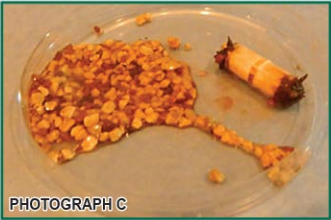
After the final rinsing of the dry fertilizer was removed, Photograph C was taken of what remained in the settling beaker as well as the magnetic pill used to stir the solutions.
The important part of this photograph is the magnetic pill. Close examination of the magnetic pill shows what could be termed as a mixture of iron filings and magnetic impurities. It is known that toxic heavy metals, besides being water insoluble, can also be magnetic in nature. These toxicities found in fertilizer result from native toxicities that occur in natural sources, or these toxicities result from the use of by-product minerals that are termed "spent acids." Spent acids are derived by using acids to clean metal parts for certain industries and then those acids are sold to the fertilizer industry in the name of cost control. The real term is the "solution to pollution is dilution.”
Dr. Tiedjens' chemical experience had showed him that fertilizer's raw materials could possibly contain toxins, such as heavy metals. He knew that those toxins would be harmful to the symbiotic microbes and he did not want to disturb the plant-microbe relationship. An addition of toxin through fertilizer to the plant environment could be purified by the soil microbes; however, that population of microbes is very different from the population of symbiotic plant microbes. Therefore, Dr. Tiedjens felt it was very necessary to use fertilizer materials that had very small amounts of toxins. Adding fewer toxins to the plant environment would allow a better balance of symbiotic microbiology.
Therefore, the mindset of the Growers Program from Dr. Victor Tiedjens is to create a soil environment that allows for the best symbiotic relationship between plant and soil microbes. Then, when adding to this environment, only add inputs that enhance the environment without misbalancing it for the proper soil microbiological life.
This is an excerpt from the Late Fall Growers Solution (2020) written by Research Team.
Signup for our newsletter to stay in the loop
