
Visual Revelation
To a thoughtful farmer, Photograph A will cause a cascade of realizations the longer he looks at it and the more he understands what's behind it. So here is a fact: If you need your operation to better make use of all its crop input expenses, and that has a source water component, you need to reflect on Photograph A.
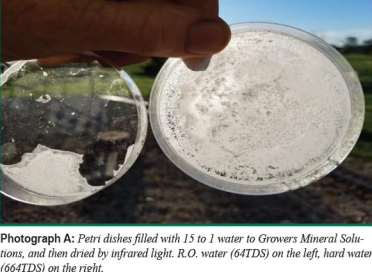
Both petri dishes were filled with water mixed at a rate of one part Growers Mineral Solutions (GMS) and 15 parts water. Both dishes were dried under infrared light, evaporating all the water. The dish to the left was mixed using R.O. water; the one on the right is a farm's well water. Since the R.O. water has few total dissolved solids (TDS) in it, the residue seen is from the nutritional "salts" from GMS plus any TDS from the water.
Unless one has ever tried to clean glass with hard well water, most of us rarely notice the "hidden" contents of one's water. But depending on the makeup and amount of the TDS of one's water, the ramifications of your farm's economic health can be huge.
We have found that adding one part of GMS to 15 parts water is an effective visual water test. If the water turns white within 24 hours, further investigation of one's water is necessary. It is important to know that this is for mineral salt interactions only, and results of this test do not address bacteria or other water contaminates. pH is another factor for the reaction to take place, and it usually takes a pH of over 7.
So what issues can occur when one has "reactive" water? Filters and nozzles on spray equipment often plug more easily. Effectiveness of anything added to the water, from fertilizers to herbicides to fungicides to insecticides-even milk replacer for baby calves-often is compromised.
To an extent, most farmers and ag suppliers know this can be an issue and recommend various pH reduction materials. They range from vinegar to ammonium sulfate to sulfuric acid, and dozens of materials in between. But the reality is, while doing a pH correction gets the added material in the water through a sprayer, it does not necessarily mean that material is as effective as it could be.
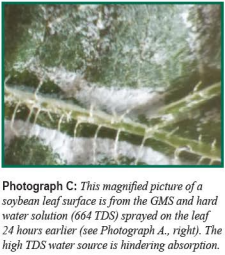
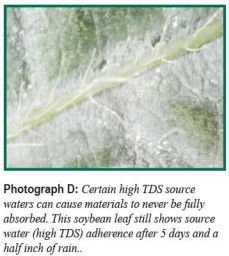
Photographs C and D show how difficult it can be for a leaf surface to absorb water with high TDS. The soybean leaves each had GMS sprayed on them at the same rate of 15 to 1. The difference after 2 days of absorption is huge. The straight-from-the-well sample is Photograph C, and it shows precipitated mineral salts, which is a mixture of GMS and TDS from the water.
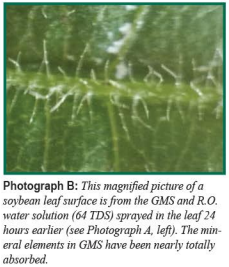
Photograph B shows little mineral salts left to absorb as the water to mix the GMS had a TDS from a filtration unit that results in a TDS of 64. This is why customers who use rainwater for their source water for their spraying equipment notice huge differences in effectiveness of anything they add to the water.
Larger operations find it difficult to "catch" enough water, or drought periods make it difficult to have enough water on hand. High quality reverse-osmosis units now exist to provide a steady amount of low TDS water, saving farmers thousands of dollars resulting from poor results from materials added to low quality spray water.
Lower TDS source water leads to huge input savings and easier management of greenhouses and gardens when used as an irrigation source. This is because the mineral type and amounts can interact with the soil mineral salts, leading to a buildup of TDS in soils, something we are seeing more in the fields as overuse of fertilizers and chemicals appear to have a negative effect on soil mineral salt migration (like phosphate migration to the rivers).
Also, as recently as December, 2018, the web site accuweather.com discussed the negative effects on soils and plants of large amounts of sodium chloride (NaCl), potassium chloride (KCl), and calcium chloride (CaCl2) used as deicing agents in North America.
Bottom line: learning and addressing your source water chemistry is a very effective way to save you money in those tough economic times, far more than one may have ever realized. Your GMS representative can help guide you through understanding your water and what can be done to mitigate its negative affects on your bottom line.
Total Dissolved Solids: The sum total of mostly mineral elements (calcium, magnesium, sulfur, iron, trace elements, heavy metals, etc.) measured by inducing an electrical flow through the water and recording its resistance. Pure rainwater will record a TDS of near zero. The farm well water used in this article records a TDS of 644. In nanotechnology, a particle is defined as a small object that behaves as a whole unit with respect to its transport and properties. See www.wikipedia.org.
This is an excerpt from the Winter Growers Solution (2020) written by Matthew Gooding.
Signup for our newsletter to stay in the loop
