
GMS and Soil Microbiological Life
In the Spring 2019, Volume 32, Issue 2 edition of The Growers Solution, a photograph from a Growers Mineral, Corp. project showed how wheat roots grew toward blotter paper saturated with Growers Mineral Solution (GMS) and would not grow toward blotter paper saturated with another type of conventional fertilizer. The conclusion was that the Growers Mineral Solutions (GMS) offered nutrition that the plant preferred which was demonstrated by the growing roots. With that in mind, we decided on a project to demonstrate if soil microbiological life would react the same way to GMS in relation to a competition fertilizer.
Following a similar type of design, an older grass sod crop was used to supply the soil microbes (with the swabbing technique) and then those microbes were exposed to the different fertilizer materials. Most farmers realize that after several years of forage growth (sod), the soil exhibits very desirable properties to allow profitable crop growth which we believe is the result of symbiotic microbiological life. How to show these soil microbes' reaction to various fertilizers would be somewhat of a challenge.
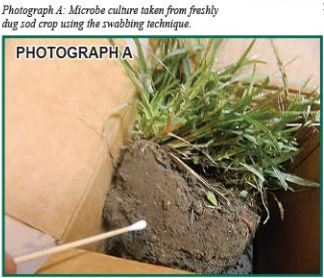
It turns out that the project design worked very well and was completed before the arrival of the COVID-19 virus. However, the arrival of the virus confirmed that the project design was done correctly. Since soil microbes are microscopic, invisible to the human eye, they had to be grown in quantity on media so as to be seen by humans. The way this is accomplished in microbiology classes (and with some viruses) is by the use of the petri dish, which contains nutrients in an agar media, or what is termed as the agar plate. The agar plate facilitates growth of the microbes to a number that makes them visible to the human eye. In this case, the microbiology of the soil (sod) was placed on the growth media by swabbing (just like the COVID-19 test) the side of the grass sod (see Photograph A above).The soil microbiology was placed on the agar plate in an "S" shape. Then on one side of the S, a line of GMS was placed on the agar plate, and on the other side of the S, a line of 10-34-0 fertilizer was placed. This agar plate was then allowed to incubate for a given period of time.
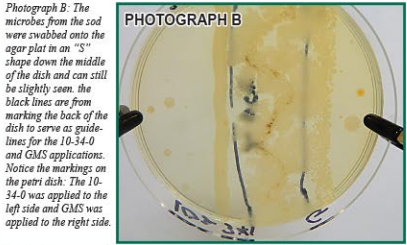
Photograph B (See above) shows the results of the growth on the agar plate. The S shape of the applied microbes was still slightly visible from the growth pattern, but it was quite obvious that the soil microbes had fully covered the GMS application side while resisting the 10-34-0 application side. This difference was seen by the growth of soil microbes (brown) covering the blue line on the back of the petri dish. This blue line indicates where the various fertilizers were placed on the agar medium. The GMS blue line is almost completely covered in brown, whereas the 10-34-0 blue line is very visible. We believe this project confirms that the quality and balance of the materials used to formulate GMS is very readily used and is, in fact, preferred by sod microbes over other types of materials used to formulate competition fertilizers.
As this article discussed earlier, the methods used in this project are very similar to the methods used by the various world health organizations in tracking the COVID-19 virus.
This is an excerpt from the Late Fall Growers Solution (2020) written by Bruce Stephens and Jim Halbeisen.
Signup for our newsletter to stay in the loop
