
GMS is Very Unique
In recent years, Growers Mineral, Corp. has invested in projects (research) to demonstrate how Growers Mineral Solutions (GMS) and the Growers Program creates success for agricultural producers. At Growers Mineral, Corp., these projects (or research) are termed "content marketing." Content marketing is discovering information that helps farmers-or really anyone looking to grow quality and economically viable food or feed for animals. Manufacturing fertilizer is what we do at Growers Mineral, Corp., but it doesn't define us. We are about creating sustainability for production agriculture and society as a whole. The ideas behind these projects sometimes are very straightforward, but at times the project sends the original ideas in a totally different direction. For example, a project comparing how GMS solubility compares to other products resulted in a very interesting photograph.
During this project, one gallon of GMS was dehydrated of all moisture and then the resulting product was re-entered into the original gallon container. It seems the resulting dehydrated material expanded enough in volume that it was impossible to fit that dehydrated material back into the original one gallon container. The photo shows the original volume of GMS next to the volume of dehydrated GMS. So why does the dry material in GMS seem to grow in size after the dehydration takes place?
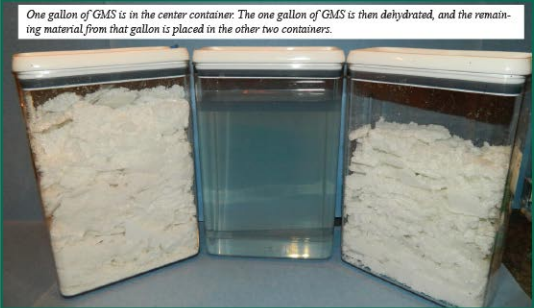
Most GMS customers know a little bit about this phenomenon by observing areas in their operations where GMS accumulates and is allowed to dry out. Many customers have seen the resulting GMS crystals after several days of dehydrating. These crystals are the result of the GMS manufacturing process. A true hot mix process creates a chemical reaction that results in a crystalline structure because of the way the elements become bonded together in the "hot" mixture. This crystal formation allows the water molecules to fit into the structure of the crystal lattice better so that a "true" solution occurs. The true solution does not segregate over a period of time. This is critical for farmers, particularly livestock and vegetable farmers, to ensure that all the minerals (elements) in GMS remain uniform within the used material.
Whether you have a thimble full or a semi load of GMS, the elements are not segregated but remain constant in the given volume.
During the project, the crystalline structure of the dehydrated GMS would have to be compromised to fit back into the original one gallon container. A new project will explore how much more space is needed to accommodate the crystals in GMS without breaking the structure of the crystals.
Incidentally, some competitors claim they are "hot" mix materials, but when they are dehydrated, very few crystals even appear. This is because it is difficult and dangerous to create enough heat to form the "true" solution which will contain a high level of crystallization and solubility. It is cheaper to make suspensions that segregate. If a so-called "hot mix" fertilizer ever "settles out," it is not a true "hot mix." The term used to describe this "cold mix" method of suspension is "vigorous agitation to maintain suspension." Also, every process besides "hot mix" is significantly cheaper to use in manufacturing. Same as Growers, only cheaper!?
Also, Growers Mineral, Corp. has started investigating crystallization images from research by Lifevision Lab of Soyana. These individuals believe the crystallization images of plants may reveal the quality of the plant and its ability to deliver nutrition to consuming animals. Again, Growers Mineral, Corp. has another project.
This is an excerpt from the Early Fall Growers Solution (2020) written by Growers Research Project.
Signup for our newsletter to stay in the loop
