Is Agriculture Ready for MAHA?
In 1966 an article in the Nowalk Reflector quoted Dr. V. A. Tiedjens as part of their publication:
"Applying dry fertilizer to the surface of the soil is, to him, the height of folly and waste. 'More of it is washed into the Mississippi and other rivers than reaches the plants for which it was intended', he avers. 'Through smaller streams, it finds its way into our lakes and instead of growing crops, it helps produce the algae that nobody wants and is spoiling recreation waters.”
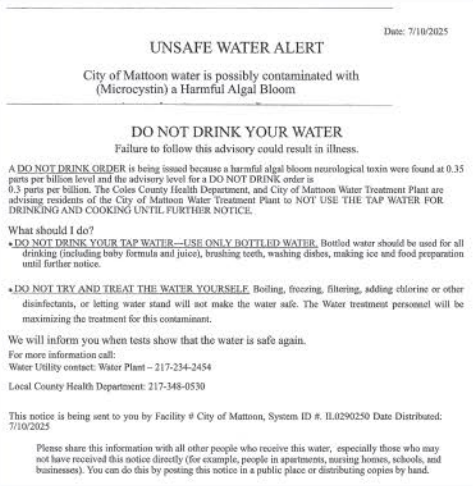
On July 15, 2025, I received a text that is presented in Figure 1. This particular notice made me think of Dr. Tiedjens comments from 1966. However, his quote only said that recreation waters are being spoiled. After the Toledo, Ohio mess on August 2, 2014, the public knows very well that Dr. Tiedjens should have discussed spoiling drinking waters as well as "recreation waters."
After the Toledo, Ohio mess (which affected my Certified Registered Nurse Anesthetist (CRNA) daughter), Urban Lehner from The Progressive Farmer concluded his article of August 5, 2014 with "one or two more tap-water cutoffs and the stick may be inevitable." He of course was saying government has 3 tools to deal with a society problem. Those tools are education, regulation, and subsidies. Since 2014, government has chosen increased education and subsidies to try and control the problem of fertilizer loss into the environment. Some farmers say that homeowners, golf courses, and parks are just as responsible for microcystin as agricultural producers. That argument was termed "old school" after the US Geological Survey published in the 1990's that agriculture was the largest contributor to the Dead Zone in the Gulf of Mexico (America).
In recent times, Growers Mineral, Corp. has published articles discussing the feature articles in agricultural and nonagricultural literature which contain discussions about the continued problem with nutrient loss into the environment. The fact that these discussions are still occurring must mean that fixing the problem hasn't yet happened.
Thus, as society continues to see notices like Figure 1, is Mr. Lehner correct assuming that the carrot is education and subsidies with regulation is the stick? Growers Mineral, Corp. contends that the ideas of the Growers Program can help a producer deal with the possibility of the stick (regulation) in the future. Some farmers say that the stick is an impossibility because of mass starvation. However, farmers need to examine the hearings of the House Agriculture Committee on the MAHA threat before deciding whether the stick could not be used to deal with the water issue at Mattoon, Illinois.
This is an excerpt from the Spring Growers Solution (2026) written by Jim Halbeisen, Director of Research.
Signup for our newsletter to stay in the loop
