
A Different Soil Sampling Trial
My first recollection of soil testing started at around the age of ten. I would follow my Dad through the fields taking soil samples of the farm. I remember how difficult it was to obtain a subsoil sample as the newly purchased farm had yet to receive the amounts of high calcium limestone to overcome years of neglect.
Over many decades, my faith in soil samples was never good. That view was enhanced when I did a root pH study in rockwool grown hydroponic tomatoes. The rise and fall of pH around the roots would often span a couple of points on a pH scale. And that was within a 24- hour period!
I always found it odd that local co-ops took soil samples in the late fall months when nothing was growing and the soils were cold, so I decided to put together a soil test trial that would last throughout a growing season.
Starting the first week of May, a grid was established and a soil test taken every Sunday night, both topsoil and subsoil. The plot was in a 13 acre two year-old clover/grass hay field.
Soil temperatures were also taken at the 2" level and at the bottom of the test hole. Daytime highs and lows, along with rainfall the week prior to the test being taken, were also recorded.
The average high and lows of the 27 week, 54 test trial are highlighted in Figure 1. This is a trial that, the more you look over the numbers, the more is realized, especially when taking into consideration the rainfall, and soil and air temperatures!
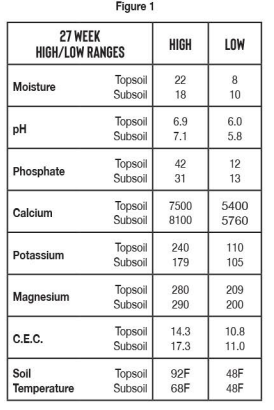
A few other general observations were noted as follows:
Changes in the result numbers seen after high rainfall or when the crop was cut.
Dramatic jump in soil phosphate numbers (even in the subsoil in a clover/grass hay stand!) after foliage feeding GMS.
Lowest soil moisture numbers did not necessarily equate to lower nutrient numbers.
pH numbers were wide ranged, more so in the subsoil (which was very dry throughout the year until September).
Clover/grass hay from this test field averages 1.5 potassium to 1 calcium. Yield, despite mostly drought conditions, would be considered slightly above expectations.
When auguring out samples, there was a big difference in difficulty drilling samples when soil moisture dropped below 12!
Much was learned and more will be talked in the future about this trial at seminars and in written articles, and refinements will be made for this year with further trials planned.
Has my faith in soil sampling improved? In some ways, yes. But in many more ways, no! Like a tool in your shop, soil sampling has a defined purpose, but too often it is used to make decisions out of context and logic, much like when one uses a crescent wrench as a hammer.
This is an excerpt from the Early Fall Growers Solution (2021) written by Matt Gooding, Research & Education Team.
Signup for our newsletter to stay in the loop
