
More GMS Characteristics
The Early Fall, 2020 Volume 33, Issue 4 edition of The Growers Solution discussed in the article "GMS is Very Unique" the importance of the "hot mix" technique for manufacturing GMS. The "hot mix" manufacturing technique allows the elements that are placed in the formulate solution to chemically react with each other in a way that gives the best stability to the solution. This stability assures the user of the solution that all elements in the solution remain in uniform proportion throughout the solution. This is a critical factor when certain elements are part of the solution in small quantities (trace elements). For years, farmers have been told it doesn't matter whether you have a "thimble full" or a "semi load" of GMS, the concentration of elements are the same in either volume. So to show farmers that GMS has this excellent uniformity, the research group expanded on the dehydration project discussed in the Early Fall 2020 edition of The Growers Solution.
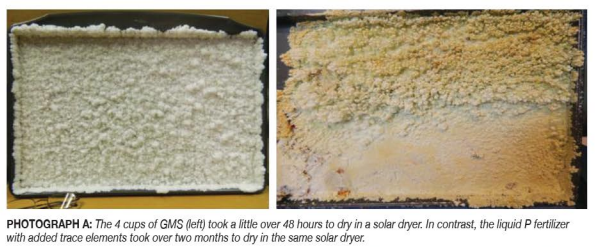
In the new project, GMS was compared by solar dehydration to another liquid phosphorous (P) fertilizer that is used as a starter fertilizer. Notice in Photograph A the difference between GMS and the other liquid P fertilizer when examining the crystalline structure after dehydration. The uniformity of the GMS structure as compared to the other liquid P fertilizer is very obvious. This uniformity is directly related to the uniformity of a true liquid solution. Crystal growth from liquid solutions are directly related to how the elements in the solution are chemically bonded together. The more stable a solution becomes, the more uniform the crystals become in the dehydrated structure. This uniformity is directly related to the chemical reaction in the formulation process. The introduction of the heat in the "hot mix" creates the best environment for stability. (Ever weld two pieces of metal together that have been preheated?) This stability from the chemical reaction allows the solution to stay uniformly mixed for a prolonged period of time. This is why GMS made in the 1950's was still uniform and clear when found in the early 2000's. This is why, when GMS is used for fertilizer or feed, the elements in GMS will always be in correct balance with each other.
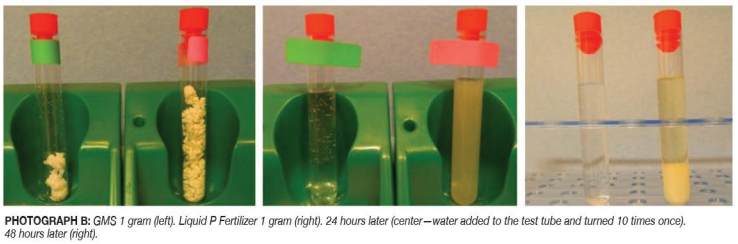
To take this project one more step, samples of each solution were rehydrated after being dehydrated. Photograph B shows the results of the rehydration test.
A key point about the rehydration part of the project relates to the stratification of the solution related to the solution's insolubility. When the dehydrated materials were added to the water, only the GMS totally dissolved back into solution. Therefore, any fertilizer that segregates before being used and needs agitation will continue that segregation process each time the physical mixing stops. Every farmer should consider that when adding brown bag trace elements to a fertilizer mixture. The results of the segregation changes the uniformity of concentration. A livestock feeder probably would not feed an agitated brown bag mixture to an animal because of its lack of concentration uniformity. However, fertilizer agronomists see nothing wrong with using an unbalanced concentration when feeding a crop and its symbiotic microbes. Also, once a liquid fertilizer becomes dehydrated, as with dry weather after planting, is that product utilized correctly by the plant if the product does not totally resolubilize back into the water?
The "hot mix" method of formulation does not lend itself to low-cost production, but it results in a true solution that has many outstanding characteristics for agricultural production.
This is an excerpt from the Late Fall Growers Solution (2021).
Signup for our newsletter to stay in the loop
