
Repeat Performance
Back in 2018, a simple experiment was done using blotter paper, a petri dish, and some winter wheat seeds (Fig. 1). The layout of this experiment consisted of sprouting wheat seeds on a narrow piece of blotter paper saturated with pure water until the seeds sprouted (Fig. 2).
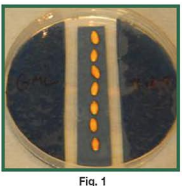
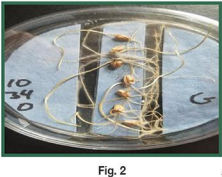
Once sprouted, the half moon pieces of paper were soaked in the various fertilizers at the listed dilutions and returned to the dish which was then covered and placed in a dark place. No additional water or solution mixtures were added.
The original experiment involved 10-34-0 and GMS at 200 parts water to 1 part fertilizer. 10-34-0 is a high salt index material, and at 200 to 1, the roots retreated to the GMS side mainly due to the GMS having a lower salt index. The purity of GMS and trace element content was also clearly attractive to the roots. As so often happens, one interesting test leads to another and so comparison was made with GMS and a similar analysis fertilizer. But this time, the ratio was bumped up to 500 to 1 and with a narrower salt index between the GMS and the 9-18-9 it was felt the roots' decision would be based more on the quality, quantity and purity of the fertilizers.
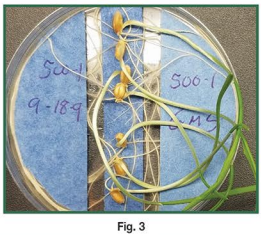
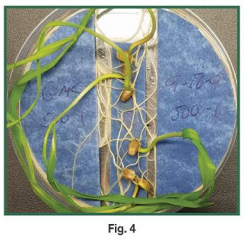
As one can see (Figs. 3, 4), the roots favored the GMS more so than what we would have thought at a 500 to 1 dilution! In addition, the study was done with a double-reversed format in that the saturated samples were put on opposite sides to take away a comment from one viewer of the original experiment that seed roots always emerge and first head to a true northerly direction. Note how even the seeding tops grew toward the GMS in both samples!
There are many discussions and realizations that come from these types of experiments, along with a few more observations that space does not allow us to list.
One would find a talk with your local GMS representative or a member of the GMS research and education team well worth your time as there are many like-designed experiments that can be accessed for a farmer's educational benefit.
This is an excerpt from the Spring Growers Solution (2021), written by the Growers Research Team.
Signup for our newsletter to stay in the loop
