
Soil Test Dilemma
In the spring of 2019, Steve Cuddeback from Skaneateles, New York sent Growers Chemical Corporation an article for The Growers Solution about his Mom's garden. In the article, he discusses the large amount of high calcium lime that he had applied to this area of the farm (Mom's garden). He mentions the fact that the garden was quite successful, so he was curious what a conventional soil test would look like for the garden.
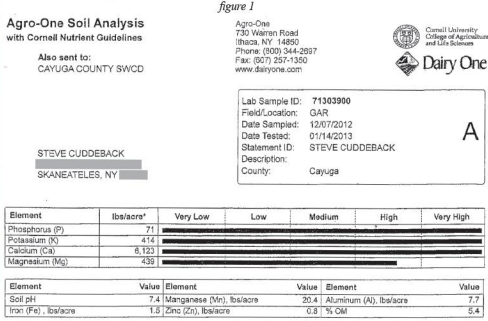
His curiosity stems from the fact that the garden was so successful and the fact that the agricultural establishment places an extreme amount of financial importance on the need for soil testing. The initial soil test Steve had done was completed in 2012, and those results are discussed in his article and shown in figure 1. Since 2012, Steve has lost even more confidence in soil testing, so he did another soil test of Mom's garden in April, 2019.
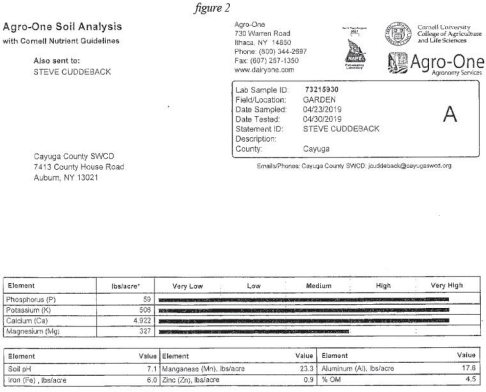
The test of 2019 (figure 2) I believe needs to be discussed with the technical expertise of the agricultural establishment. When comparing the 2012 and 2019 tests, it seems according to the establishment that the soil is losing some of its fertility because of the removal of nutrients by the harvested crops, since very small amounts of added fertility are used to replace that which is lost to crop removal.
I told Steve and his son Jason that they need to keep adding more P, Ca, and Mg nutrition to the soil so as to prevent the loss of those key minerals to crop removal such as they had been doing with the added K, because the K reading in the soil had increased from 441 pounds per acre to 508 pounds per acre, a 23% increase in the K level of the soil. However, there was a problem. Seems that the Cuddebacks had not added any source of K to Mom's garden from either fertilizer or manure.
Jason said Grandma was pretty fussy about what got put on her garden. She made it clear enough so that the boys didn't mess around with applying any type of junk to her area of the farm. Those farm wives were not agricultural establishment savvy, just very protective of their families.
So the question is, why, with the unit in and unit out technology of the soil test, did the K level of the soil test increase 23% when no K was added to the soil in that time frame?
a. Accuracy of the test
b. Laboratory technique doing the test
c. Both a and b
d. The test is meaningless
e. All of the above
The answer to the last question can be found on any farm by the use of crop strip plots.
This is an excerpt from the Late Fall Growers Solution (2019) written by Jim Halbeisen, Director of Research.
Signup for our newsletter to stay in the loop
