
How Rhizophagy Works
THIRD OF A SERIES
With the arrival of the rhizophagy cycle concept Dr. James White has written and discussed in great detail the key principles of the cycle. In the scientific paper "Endophyte Symbiosis: Evolutionary Development and Impacts of Plant Agriculture" which appeared in the publication Grass Research in 2023 Dr. White summarizes how the rhizophagy cycle works:
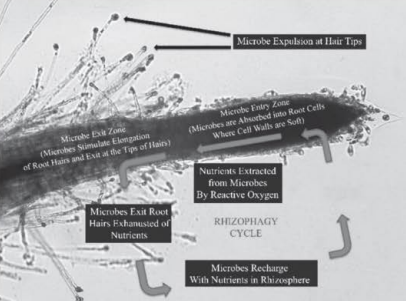
The diagram showing the rhizophagy cycle, with a schematic of a root, with root cap to the right and developing root hairs to the left. In the rhizophagy cycle microbes alternate between a free-living phase in soil and an intracellular phase in root cells. The microbes obtain nutrients in the soil phase, and nutrients are extracted by the plant from microbes oxidatively in the endophytic phase inside the root. Microbes are expelled from root hairs at the tip where they reform cell walls and reenter the soil to acquire additional nutrients. Source: Chang X et al. 2023. Endophyte symbiosis: evolutionary development and impacts of plant agriculture. Grass Research 3:18.
During a podcast with questions and answers about this research in Grass Research Dr. White summarizes the rhizophagy cycle:
"The process gets underway by plants secreting exudates at their root tips which serve as signaling molecules to attract beneficial communities of microbes.”
"Once attracted to the root tip meristem, microbial communities are internalized by the plant - the exact mechanism hasn't been described yet. Once inside the root tissues, the plant produces superoxide which oxidizes the bacteria, stripping off the bacterial cell walls to leave protoplasts. It is from these that the plant extracts nutrients.”
"What happens next emphasizes how plants are dependent on microbes not just to help feed them, but also for their root hair development - these massively increase the surface area for absorption of nutrients and water. They do this by secreting substances such as ethylene, nitric oxide and other hormones that trigger root hair elongation.”
"Some of the bacteria that survive the process are then ejected back into the soil from the tips of elongating root hairs, where root exudates encourage their cell walls to reform. And the cycle begins again as the microbes migrate away from the root to acquire nutrients and then return to the root tip, attracted by plant exudates. Rhizophagy is a system common to all plants with root hairs and without it, root hairs can't develop."
Studies have concluded that early, simple land plants were able to survive by using symbiotic relationships with microbiological life. Due to physical limitations and harsh environmental conditions plants adapted these very important relationships with microbiological life. Early land plants as well as modern plants interact chemically with internal microbes to obtain elements that are necessary for growth and survival. Science refers to microbes that were internalized by plants as endophytes. Rhizophagy is a process where plants acquire microbes from the bulk soil through the plants' root systems. The exact mechanism for internalization has yet to be determined.
In the rhizophagy cycle plants attract soil microbes to root tips by secretion of root exudates. These exudates are composed of sugars produced during photosynthesis, organic acids, and other nutrient sources. Once the microbes are absorbed, plant cells produce super oxides that strip cell walls off the microbes allowing the ingredients in the cell wall of the microbe and the total microbe itself to be available to the cell of the plant.
Once the microbes have been exposed to superoxide some of the microbes that are not totally broken down in the plant can be ejected from the tip of the formed feeder roots. At the same time the feeder root ejects sugar exudate that assists the newly ejected microbe to reform its total structure. At this point the cycle begins again as the microbes migrate away from the feeder root to acquire nutrients and then return to the root tip attached by plant exudates.
This is an excerpt from the Winter Growers Solution (2026) written by Jim Halbeisen, Director of Research.
Signup for our newsletter to stay in the loop
