
More confirmation for Dr. V.A. Tiedjens
Since 1955 when Dr. V.A. Tiedjens brought Growers Mineral Solutions (GMS) and the idea of applying mineral elements to the above ground portion of growing plants to the agricultural market, the use of foliar applied elements for plants has not been considered a viable option by many in the agricultural industry. However, in recent years with the problems of lost fertilizer elements into the environment, technical studies conducted outside of the agricultural industry have examined methodologies to try and reduce the problems with lost elements into the environment.
One such study was released by Carnegie Mellon University College of Engineering at Pittsburgh, Pennsylvania. The title of the study, which was published at www.engineering.cmu.edu, is "A New Delivery Route for Plant Nutrients." A photographic summary of their research is shown here.
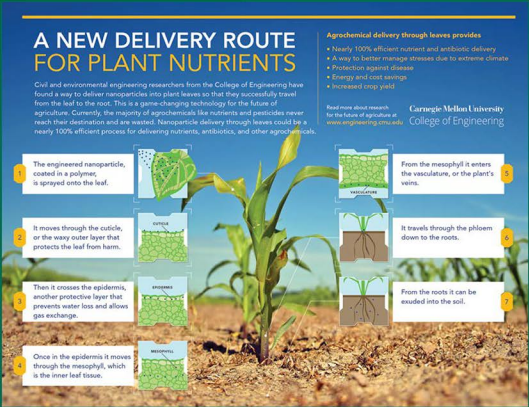
Infographic courtesy of Carnegie Mellon University School of Engineering. Used by permission.
This research uses the science of nanoparticles to demonstrate the validity of nutrient transport to plant roots by way of application to the above ground growing portion of the plant. The published summary discusses the movement of the elements through the physical structure of the plant with possible passage of the elements all the way to the plant's root zone.
"Once the nanoparticles are sprayed onto the leaf, they move through the cuticle, which is the waxy outer layer covering the leaf. Then, it crosses the epidermis. The cuticle and epidermis are layers that protect the leaf from harm, prevent water loss, and allow gas exchange for the plant to breathe.
"The nanoparticle then makes its way into the inner leaf tissue or mesophyll. Finally it moves into the vasculature of the plant, or the plant's veins. From there it can travel all the way down the stem and into the root, or up to higher leaves."
"For the first time, the researchers demonstrated that once reaching the roots, nanoparticles can be exuded into the soil, adhering to the microenvironment that sticks to the roots called the rhizosphere. The rhizosphere is where the plant interacts with the soil, takes in nutrients, releases small acids, carbon dioxide and proteins, and where bacteria and fungi can enter the plant. The only methods currently available to treat an unhealthy rhizosphere are mixing agrochemicals in the soil or applying water with the chemicals. In both cases a large amount of the chemicals are lost. What the researchers have demonstrated is 100 percent efficient delivery that can decrease the amount of chemicals needed, lower the cost, and limit environmental contamination."
This research, as did the radioactive trace element studies at Michigan State University in the early 1950s, substantiates the approach that Dr. V.A. Tiedjens proposed with the introduction of Growers Chemical Corporation and the product Growers Mineral Solutions in 1955. However, in today's world, these engineers look at the efficiency of this delivery of elements to the plant as "nearly 100% efficient" which will "limit environmental contamination.'
With the published problems in the Chesapeake Bay; the Gulf of Mexico; the city of Des Moines, Iowa; and Lake Erie, farmers must consider the consequences of future environmental regulations when selecting a fertilization approach for their farming operations.
This is an excerpt from the Spring Growers Solution (2020) written by Jim Halbeisen.
Signup for our newsletter to stay in the loop
