
Go with the Pros: Proper Foliar Feeding
2019 proved to be an especially difficult year for growing crops. A wet fall led into a wetter spring, preventing many in certain parts of Canada and the US from planting part or all of their land. This, of course, means that they didn't use the fertilizer they normally would for planting, leaving companies and co-ops that sell said fertilizer short on income.
Even though most suppliers are against foliar feeding, the lack of starter sales has caused some of them to take a closer look at recommending foliar products in order to make up some of that financial shortfall (and, ahem, to ensure we don't mine the soil...). However, what happens when you mix an organization with little to no foliar feeding experience, with a customer with the same lack of experience, with unclean products? The photo below shows us exactly what you get: burnt crops (in this case, corn).
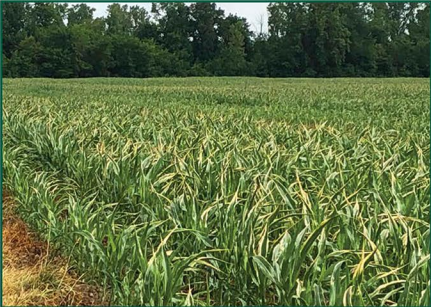
We don't know exactly what went wrong in this picture, outside of knowing it was caused by a foliar product. It could be an unclean product, it could have been sprayed at the wrong time of day or otherwise in the wrong conditions, it could have been accidentally (or intentionally) mixed with another product that it didn't react well with, it could have been mixed with reactive water, and/or it could have been sprayed in a mist not fine enough. The list goes on, to be sure.
What's important to point out is that all of these causes are completely avoidable with the right knowledge and work ethic. Foliar feeding is a fantastic and efficient way to feed your crops if it is done properly. Work ethic cannot be supplied, but going with a company that has been foliar feeding for 65 years certainly goes a long way toward solving the knowledge issue. That company is Growers Mineral Solutions.
Before the science of foliar feeding was even accepted in a minor level, Dr. Tiedjens, who is one of Growers Mineral Solutions founders, was already developing a formula for a liquid fertilizer and an accompanying program that included foliar feeding in a big way. He understood the economic and nutritional efficiencies that could be gained by targeting the product onto the leaves, stems, and bark. Since then, we have seen massive success in properly applying a clean and pure foliar product (our only product, the 10-20-10) across a very wide range of soil types, crops, and climate conditions. All of our representatives have great knowledge on how to properly foliar feed, as most of them have done it for years themselves, and all of them have read the research supporting it. Also, environmental research conducted by Carnegie Mellon University's College of Engineering demonstrated that, by applying nutrients to the plant leaves correctly, a delivery system occurs which "can decrease the amount of chemicals needed, lower the cost, and limit environmental contamination." (See "More Confirmation for Dr. V.A. Tiedjens" on Page 1 in this edition of The Growers Solution.)
All of this said, don't let a picture of damaged corn scare you away from foliar feeding. The problems lies not in the practice itself, but in how it was done, and what it was done with. We at Growers Mineral Solutions have a product that works for foliar feeding as well as with other applications, and the experience and knowledge to back it up.
This is an excerpt from the Spring Growers Solution (2020) written by Zach Smith.
Signup for our newsletter to stay in the loop