
Foliar Feeding Season
Late May and early June generally kicks the foliar feeding season into high gear. GMS is applied shortly after first cutting hay; when corn is close to knee-high-V6 to V9-growth stage; and to early reproductive vegetable plants. This is the time of year Growers Chemical Corporation needs to remind producers about the protocols of foliar feeding.
The protocols discussed by Growers Chemical Corporation in the past have remained relatively consistent, and that is fine for most of the foliar feeding protocols. However, the water chemistry discussion, which is more complex than the other procedures, needs some increased scrutiny.
UNDERSTAND WATER CHEMISTRY
It is not necessary to add water to GMS when foliar feeding. However, for convenience and to accommodate the spray tips in their sprayers, most producers do use some water dilution when foliar spraying the crop with GMS, especially at lower rates (1 to 2 gallons per acre).
If the water volume mixed with GMS is less than the volume of GMS, water quality is important only if particulate matter (dirt) is present in the water. However, whenever the volume of water exceeds the volume of GMS in the spray solution, it is very important the dissolved solid level, or hardness, of the water be addressed. Water containing certain levels of dissolved solids must be acidified, otherwise it may chemically interact with the GMS and impair the success of the GMS on the sprayed crop.
Making sure the water does not react with the GMS helps the GMS to work properly in the plant tissue and also ensures there are no physical spraying (plugging) problems from crystal accumulations.
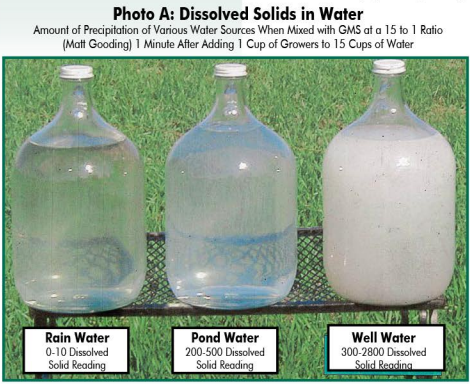
Photograph A included in this edition of The Growers Solution shows the difference in dissolved solid precipitation for various water sources. Usually, the lower the dissolved solid content of the water, the less mineral precipitation occurs with the water when mixing with GMS. Even though this precipitation can be prevented using various chemical additions (acidifiers), those accumulated minerals are still present in the final mixed solution. What that means is. even though those accumulated minerals can be kept dissolved in the spray solution, once they are applied to the plant tissue they may precipitate out into a dry form that covers the plant tissue. If that dry form is concentrated enough, it could coat the plant leaves, interfering with photosynthetic activity.
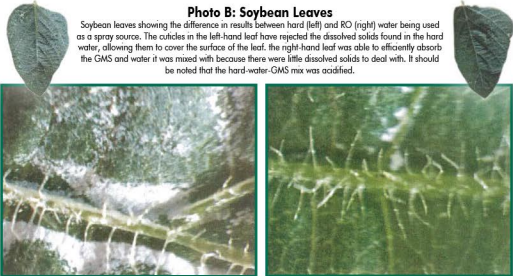
Photograph B (see above) shows the difference in results of spraying soybean leaves with hard water vs. reverse osmosis (RO) water (both mixed with GMS). The cuticles of the leaves were unable to absorb the dissolved solids present in the hard water, and so they were left on the surface of the leaf. Well water will deposit more dry minerals on the plant leaves than rainwater or RO water. Our research is showing that the success of foliar spraying GMS is improved by lowering the amount of dissolved solids in water that is used to spray GMS rather than simply keeping them in suspension.
PRECAUTIONS
As the new age of genetic modification brings old herbicides to new uses for weed control, it is very important for producers to follow proper protocols.
Achieving the best coverage and smallest particle size usually requires higher spraying pressures. When spraying, GMS pressures over 40 psi tend to create smaller particle sizes. If drift is a concern when foliar spraying, tend toward the highest pressures recommended for the type of nozzle being used. Foliar feeding with minerals (elements) is similar to spraying a fungicide in that the plant needs as much coverage as possible with small particle sizes.
DO NOT SPRAY IN THE HEAT OF THE DAY
The cuticle (skin or covering) of the plant leaf has a lot of openings which allow moisture to penetrate the leaf and its internal cell structure. Any minerals (elements) dissolved in the moisture penetrating the plant's cuticle become part of the internal structure of the plant and helps plant growth.
Foliar feeding is the most successful when applied to plants which have accumulated moisture on their leaf surfaces. Growers Mineral Incorporated suggests producers foliar spray: late in the evening; early in the morning; on overcast or foggy days; or when the leaves have, or will shortly have, some dew moisture on them which will help the minerals contained in the GMS to be dissolved into the water and then the water is absorbed by the plant.
STRAIGHT OR WITH LITTLE DILUTION
Foliage spraying GMS straight and without water dilution shouldn't be considered a "forgotten art," not yet, at least. It was the rule, not the exception, in the early years of Growers Mineral Inc. Chances are, though, many newer Growers customers haven't yet considered the option.
Most present-day spraying is done at spray rates of about 10 to 20 gallons per acre to facilitate herbicide, fungicide, or insecticide spraying. When GMS is added to these high gallon mixes, hard water issues sometimes appear. GMS and hard water often do not combine well. The phosphorus in Growers and the calcium in the hard water tend to form a milky mixture in the spray tank. The fallout makes some of the beneficial nutrients in the Growers not available to feed the crop as intended. Also, sometimes mechanical problems can be an issue, such as spray tip and screen plugging.
Hard water does not always cause problems, especially when the mix ratio is in the one-part water, one-part GMS range. This means the producer could effectively double his spray rate from 2 to 3 gpa to 4 to 6 gpa and still not encounter hard water issues. But staying with the lower spray rates means less frequent time-consuming stops to refill the spray tank.
Avoiding the hard water problem altogether, many Growers customers spray their GMS at the recommended rates, straight, without dilution. This is done with low volume spray tips available from Growers and most ag equipment suppliers.
MIXING WITH OTHER PRODUCTS
Excellent results can be expected when the product is used in accordance with Growers' Recommendations for Using. Poor results can be expected if GMS is used with any material other than uncontaminated water in the application. Nothing expressed or implied shall change the Growers Recommendations for Using when the Growers product is used in conjunction with the product of another manufacturer regardless of the other manufacturer's recommendations.
Farm operators foliar feeding GMS for the first time, and to ensure success, should use their GMS sales representative as a knowledge resource.
This is an excerpt from the Summer Growers Solution (2020) written by Jim Halbeisen and Zach Smith.
Signup for our newsletter to stay in the loop
