
Important Foliar Feeding Notes
Foliar feeding is an excellent way of getting efficient nutrition to the plant very close to stress points when it needs it most. With late spring/early summer comes many opportunities to foliar feed, from hay and row crops to fruits, veggies and tree crops. That said, there are several things to take into consideration before trundling through that field or patch with the sprayer going full bore.
WASHING AND MIXING PRECAUTIONS
Since many people's sprayers are used for multiple products including fertility and various pest and weed control products, it is important to remember to wash out your sprayer of old product before going out to spray GMS. This is for two reasons: 1. Even residual amounts of herbicides, such as that left in the lines or the lining inside of a tank, are strong enough to seriously damage or kill non-resistant crops if accidentally sprayed onto them. This is especially important with newer technologies, including glyphosphate, dicamba, and 2-4D mixtures. Please follow proper tank cleaning protocols in order to avoid crop damage. 2. GMS is unpredictable in how it will react to or affect herbicides when they are mixed. Just as when mixing with some hard water, there may be precipitate that will cause efficiency and equipment problems. Also, some operators have noticed an increase in herbicide potency when mixed with GMS, causing even resistant crops some problems. It is not advisable to tank mix GMS with any other product.
FINE MIST
Foliar feeding with fertility products is most successful when as much of the plant as possible is coated in as fine a mist as possible. The pores in leaves' cuticles are very small and so will absorb small water particles much better than large ones. Spray pressures over 40 psi tend to produce the smallest particles. In addition, if spray drift is a concern, tend towards higher spray pressures for the anti-drift type of nozzle you are using. Remember, plants can absorb nutrition through their leaves and through smooth bark/stalks, so getting as much coverage as possible is in your best interest.
SPRAY TIMING
Foliar spraying should not be done in the heat of the day or in direct sunlight. This is because foliar nutrition must be absorbed through pores in the leaf surface, which will close in high heat or sunlight to prevent water loss from the plant, thereby preventing them from absorbing anything on their surface. Furthermore, since foliar nutrition must be absorbed with water through the plant surface, we advise that you spray when there is or will shortly be dew on it. Taking these together, the best times to spray are early morning, late evening, on overcast or foggy days, or anytime the leaves will have dew on them. If you do spray in high heat or direct sunlight, the risks of leaf burn and bad fertilizer efficiency are high.
SPRAYING GMS STRAIGHT OR DILUTED
GMS can be sprayed straight or be diluted in water. In the early days of the company, when low-volume sprayers were more commonplace, spraying GMS straight was by far the most popular choice. Since the use of foliar herbicides and fungicides has become widespread, higher volume sprayers have become more the norm. In such a case, GMS can be mixed with water to meet volume requirements. Spraying straight or diluted does not affect the effectiveness of GMS, barring if water of poor quality is used.
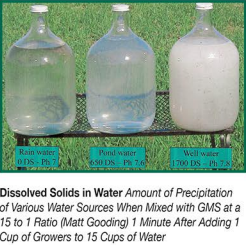
If you are going to mix GMS with water, it is best to use R.O., distilled, or rainwater because they contain little to no dissolved solids. The phosphorus in GMS can react poorly with the various elements in hard water, creating a white precipitate that reduces efficiency and can plug up sprayer screens and nozzles. However, if you keep the amount of water added under the amount of GMS, this should not be a problem.
WATER CONSIDERATIONS
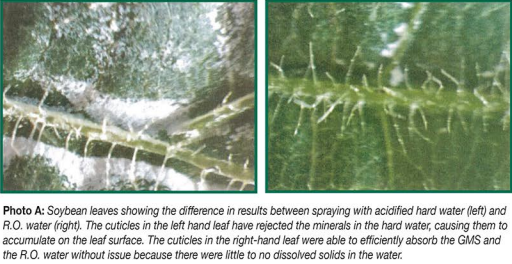
In the past, we recommended that, if you were going to mix GMS with hard water, you acidify the water first to ensure it wouldn't react with the GMS and produce precipitate. Acidifying the water will prevent the phosphorus and various elements from bonding together and precipitating out. While this will ensure that the mixture makes it through your screens and nozzles, research done over the past year and a half has shown that even if the water and GMS don't react, there is still a detrimental effect on the leaf from using hard water. Photo A shows a microscope picture of two different soybean leaves that show the difference between spraying with acidified hard water and R.O. water. The mineral left on the leaf surface from the hard water can impair photosynthetic potential, so it is important to use clean, low dissolved solid water to ensure no harm comes to the plant and you get the most out of GMS.
This is an excerpt from the Summer Growers Solution (2021) written by Zach Smith.
Signup for our newsletter to stay in the loop