
pH a Problem?
For many years the agricultural establishment has disagreed with the Growers Program's suggestion to farmers to examine the use of high calcium limestone on soil in their operations. The big discussion point always focused on the problem with "over-liming injury." According to this problem, if the farmer applied too much high calcium to the soil, this soil would become "tied up." The discussion of "tied up" always suggested that the elements in the soil, particularly the trace elements or micronutrient elements, would not be available to the growing crop. This meant that the plants would not be able to grow correctly because of the lack of available nutrition.
In The Growers Solution, Spring 2019, Volume 32, Issue 2 edition, Photograph A was published showing wheat roots growing towards blotter paper soaked with a solution of GMS as opposed to the blotter paper soaked with a 10-34-0 solution. The conclusion of this photograph was that the plant roots were growing into a preferred medium that would allow for the plant to be more successful with its growth pattern. The accompanying article with this photograph reasoned that the seedling would grow toward the healthier environment to allow the finished plant to be more successful.
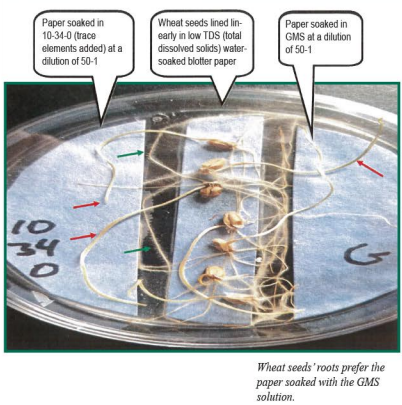
A fact that was not discussed in that particular article is the pH of the environment that resulted from using the two solutions and how the pH's of those two substances, 10-34-0 and GMS, may influence the plant's rooting mechanism. Since the agricultural establishment asserts that a high pH creates a harmful soil environment, which results in poor growth, Matt Gooding felt it would be very important to measure the pH of the products used to create the environment of the blotter papers. If the agricultural establishment is correct that a high pH in the root environment is harmful to the plant, the plant would surely resist entering toward a toxic environment.
Therefore, it is very interesting to note that the 10-34-0 used to make the less dense root environment had a pH of 6.12 and the GMS used to make the more dense root environment had a pH of 7.65.
As the old saying goes: "Very interesting." The wheat seed evidently does not read the same literature that the agricultural establishment uses to promote the term "over-liming injury."
This is an excerpt from the Late Fall Growers Solution (2019) written by Jim Halbeisen, Director of Research.
Signup for our newsletter to stay in the loop
