
Choice
Rarely does one picture produce so many topics of discussion. But this independent test with seven wheat seeds sure gives a very unbiased insight into a world rarely seen by the farming community. The closer and longer one looks at this petri dish, the more revelations occur.
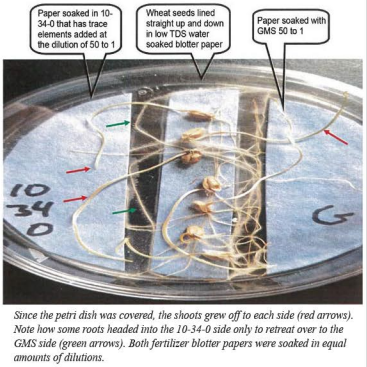
After reading the picture descriptions, it is clear that the seeds' roots prefer heading to the Growers Mineral Solution side. It is of particular interest that two of the roots (green arrows) sample a little of the "film" of 10- 34-0 leached out from the paper and then head back around into the GMS side!
Besides the obvious. the fact that they are not "burned" by the high salt index of 10-34-0, especially with added trace elements (which would raise the salt index), is fascinating. Since the roots have no soil pressure to deal with, those roots probably can move out of a zone containing a toxic salt exposure.
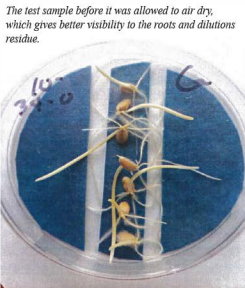
In both fertilizer solutions, the roots never entered the blotter paper completely. This is because, without the buffering capacity of soil and its biology, the dilutions of 50 to 1 are too strong. To give one a better understanding, back when I operated a hydroponic lettuce greenhouse, the starting dilution for Growers Mineral Solutions was 650 to 1! This concentration factor of the GMS demonstrated in these photographs confirms why the in furrow volume of GMS has to be adjusted to compensate for soil temperature, moisture, organic matter and texture.
We have plenty of empirical and scientific evidence over the last 63 years that soil biology thrives in the presence of GMS, but this test has neither the buffering capacity nor the biology and yet the choice is clear. This should have profound ramifications when one considers the quality of liquid fertilizers put around the seed.
Often, when one runs the numbers in terms of cost per gallon and availability of that gallon, GMS comes out on top. Add that, and now this visual aid, and the choice should be clear.
This is an excerpt from the Spring Growers Solution (2019) written by Matthew Gooding.
Signup for our newsletter to stay in the loop
