Lake Erie Bill of Rights: Summary & Growers Perspective
Water quality impairment is probably the biggest environmental issue facing agriculture. This is especially clear in the western basin of Lake Erie, where algae blooms from nutrient pollution are a big and increasing problem. The effects of the algae blooms are wide-ranging, including but not limited to tainted water, lost economic and recreational opportunity, ecological damage, infrastructure damage, and decreased land value. These impacts have captured the attention of activists and the public alike, and the Lake Erie Bill of Rights (LEBOR) is their answer to perceived inaction by those causing the nutrient pollution. This article will give a brief background of nutrient pollution in the Lake Erie watershed, the steps leading up to the LEBOR, LEBOR itself, and why we at Growers believe the voluntary measures have proven inadequate.
Beginning in the mid-1990's, harmful algae blooms slowly returned to Lake Erie. They gained the spotlight beginning in 2010 when a particularly severe bloom caught people's attention. The steps taken in the 1970's addressed point source pollution, but the main source of pollution is now non-point sources of which agriculture is a part.
In 2014, the water treatment plants in Toledo, Ohio were shut down for two days because of mycotoxin (a chemical produced by some algae species) contamination from a massive bloom in the lake. In response, the agricultural establishment, backed by the university system, began promoting voluntary initiatives to farmers to reduce nutrient loss from fields. Their hope was that this issue could be solved without burdensome regulations. According to them, if farmers only followed the university recommendations for what boils down to the 4R's, the blooms would subside and everybody would be happy. Unfortunately, the following years did not, for the most part, support this narrative. Harmful blooms occurred again in 2017 and 2018, in part because there were still too many nutrients being lost from fields. On top of that, an Ohio EPA report showed that the amount of nutrients entering the lake has not even decreased. All of this points to the ineffectiveness of voluntary measures.
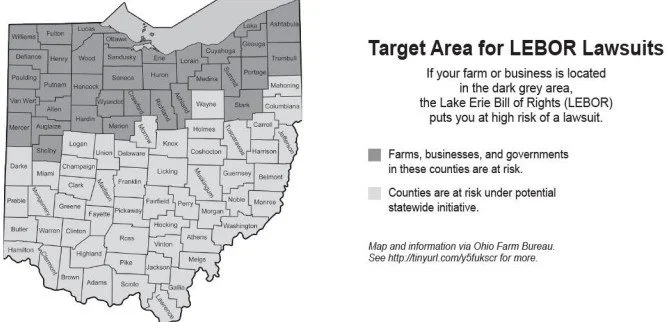
Out of this quagmire was born LEBOR. It is a charter amendment that grants Lake Erie and its watershed rights to clean water. Any citizen can sue another entity-be that individual, business, or government-they feel is stepping on those rights. Though LEBOR theoretically includes the entire Lake Erie watershed in Ohio, studies have shown that most of the nutrient pollution is entering from the Maumee River, on which Toledo is located. This is an intensely cropped watershed, and is the area that bears the brunt of the public blame for the algae blooms. Farmers in the entire watershed can be targeted, but I would imagine this area is most vulnerable (see the map below).
In quick summary of its legality, it is very unlikely that LEBOR will stand up in court. It steps far outside municipal jurisdiction to enact, let alone enforce, but it could cost quite a bit of time and money before it is repealed.
Besides exposing the danger of ignorant power, this entire fiasco proves that the establishment system for growing crops is environmentally unsustainable. Despite efforts to incorporate, slow the release of, and/or jimmy the amount of nutrients applied, the fact remains that the establishment recommends too much of an inefficient and damaging package of substances. Please keep in mind that establishment recommendations are created and supported by university extension and research services which, in my opinion, equates the two for blame. The answer must lie in drastically reducing the amount of nutrition applied to fields, and the Growers program has shown for 64 years that this can be done while still producing profitable crops.
The Growers program consists of conditioning the soil with high-calcium limestone and using a very clean, efficient, and complete fertilizer to help crops through stress periods. First of all, when the soil has been corrected with limestone, it is in a much better state to stabilize what nutrients are applied, thanks to a healthy microbiome. Second, its physical state is much more conducive to water infiltration, reducing runoff and erosion. Third, Growers Mineral Solution (GMS) is so clean that it is very quickly absorbed into the soil microbiome and prevented from running away with water. Lastly, it can be applied in such small quantities while still providing the needed punch that there is very little to lose in the first place. Clearly we don't need all of the nutrients being applied under the establishment program, since most of them are lost anyway. Growers firmly believes that many of these nutrient loss problems can be solved by simply following our program.
Information for this summary provided in part from:
Ohio governor wants new farm rules to fight Lake Erie Algae by John Seewer for AP News July 11, 2018 http://tinyurl.com/yy7dp27z
Lake Erie Bill of Rights Provided by Ohio Farm Bureau, published February 2, 2019 Reference Ohio Farm Bureau Lake Erie Bill of Rights Archives http://tinyurl.com/y4fqu451
Study shows no drop in pollutants feeding Lake Erie algae by John Seewer for AP News April 22, 2018 http://tinyurl.com/yxkgpph2
This is an excerpt from the Summer Growers Solution (2019) written by Zach Smith.
Signup for our newsletter to stay in the loop