Forgot the GMS – Again
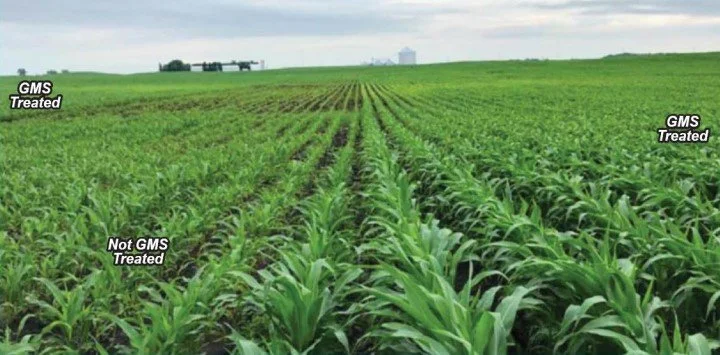
In the spring of 2018, a Growers Mineral Solution (GMS) customer got a call from his scouting service as to why he skipped planting 1/2 round in his corn field at a particular farm. The GMS customer was confused because he knew he had not skipped any area in that particular field. As the growing season progressed, it turned out that he had not skipped that area, but that the corn did not emerge as fast because he had forgotten to turn on the GMS for the In-Furrow technology (which he did remember). Eventually, the GMS customer took the photo below.
The GMS customer's comment on the picture is to notice the area away from the camera (phone) where the corn is more affected physically by the GMS addition. He says that is a higher organic part of the field that is slower to warm up in the spring of the year. Also, another highlight of the photo is the first row which did not receive GMS is bigger than the second row not receiving GMS, which shows how the improved soil microbiological activity from the GMS reaches over the 30 inch row distance to help the crop (please see The Growers Solution Winter, 2016 Volume 29 Issue 1).
The success seen with GMS during the early spring growth can be attributed to the balance and quality of the ingredients in the GMS. The effect of the GMS ingredients focuses on two different areas which help create success for the plant.
1. GMS helps the crop directly with the nutrients in GMS being absorbed directly by the plant.
2. GMS helps the crop indirectly with the GMS nutrients being utilized by the soil microbiological life.
1. Most farmers look at starter fertilizer as nutrients placed close to the plant that the plant absorbed directly to fulfill the growing needs of the crop. With this in mind, the elements (minerals) in starter fertilizer need to be very soluble so it is in a physical state (liquid) that the plant can absorb into its tissue. As far as GMS is concerned, all the elements present in GMS are in the most soluble form in the world of chemistry. The big problem with soil placement is that the elements present in the soil chemically react with the added fertilizer elements to create compounds that are not soluble which means that the added elements are not now easily absorbed by the plant. With that in mind, we can examine the second point of starter fertilizer success which is related to the biological life in the soil.
2. When starter fertilizer is applied to the soil, only a very small fraction of what is applied is utilized directly by the plant. A very high percentage of the applied elements are either chemically tied up in the soil, lost to the environment, or consumed by the biological life in the soil. The first two results are a total loss to the farmer as far as feeding the crop. (The chemically tied up elements can be measured in the soil test, but it may be in a form that the plant will never be able to use for growth.) The only usable elements are the ones that end up in the microbiological life, especially microbiological life that is in a symbiotic relationship with the desired crop. Dr. V.A. Tiedjens' experience with hydroponics taught him the balance and purity of elements to allow the maximum utilization of GMS by the microbiological life in the soil. (As a side light, the elements being consumed by the soil microbes stabilizes those elements so they are not lost or chemically "tied up.")
The science behind GMS is what allows the plant to be productive with that "dinky amount of fertilizer." See "Where Did that Yield Come From?" in The Growers Solution, Late Fall 2018, Volume 31 Issue 5.
This is an excerpt from the Winter Growers Solution (2019) written by Staff.
Signup for our newsletter to stay in the loop
