
Search for a Winning Combination
After reading the book More Food From Soil Science, knowing it was written in the mid-sixties, Pandora, Ohio farmer Mike Schulte was wondering if the Growers company was still around. After some investigation, he discovered it was and he searched for a phone number. After finding one, he contacted Growers in Milan, Ohio, and the Growers company sent district manager Ed Bulcher up to explain the Growers Program and how to implement it in their operation.
The Growers Program being so different from what they had been doing and what they had ever been taught about farming, you could say they were skeptical and even uneasy about the thought of changing and trying something new and different. It seemed to be quite risky. Knowing to do nothing to achieve their goals never improves your situation, and change is almost always somewhat of a gamble, they still weren't sure it was worth the risk. After much debate, they decided to try it on a small scale.
The first year in the greenhouse, things did not work quite as planned. Complications dealing with hard water problems occurred, and adjusting water pH and hardness was too much of a balancing act to stay on top of. So Mike soon gave up and went back to what they were doing before. In the field, they brought in a few truck loads of high calcium limestone and applied several strips which later that year showed some impressive results. I remember them saying the liming plots definitely showed improvement in yield and soil tilth. And since then, they've hauled in many truck loads for themselves and also a few neighbors' farms.
The first crop using GMS in the field was summer squash. Before, with their old fertilizer program, walking over the vines during harvest damaged the plants and they didn't regrow new foliage. This time with GMS used on the plants, they regrew new growth. The next time entering the field it was hard to see the damage from the time before. There seemed to be less disease problems and the plants produced squash two to three weeks longer than their old fertilizer program.
The second year, they started using the GMS product on their field crops. They liked how easy it was to use for row start application and now they were a little more confident with foliar feeding and understood how water hardness reacts with the Growers product, and now were more familiar with adjusting pH and hardness. Seeing improvements in the row crops was the turning point in their decision to start using Growers on their processing tomatoes. One of their goals was to increase their quality grade (peeler grade). They had been satisfied with yield but felt they could do better on the premium tomato market. Foliar feeding the tomatoes worked out well with their fungicide program. Hard water was still a problem mainly because of the volume of water used. With the Schultes looking for some technical answers on their water, I felt Mike should talk with Growers representative Matt Gooding because of his experience with water hardness. That's where Mike learned about reverse-osmosis water systems on a large scale.
In 2017, their patience was once again tested getting familiar with the new RO system. Foliar feeding the tomatoes with the RO water made working with the Growers much simpler, but during harvest they were seeing too much of the yellow shoulder which is what they were trying to eliminate in the tomatoes. They wondered if more GMS up front at planting with the RO water wouldn't do the trick.
With the new plan in place, they got ready to go to the field with the combination. In 2018, with the RO system up and running and the volume of water to work with now, they transplanted the tomatoes with five gallons of Growers two by two with the new combination. The tomato crop started out good, but soon they notice the plants looked different. The foliage seemed smaller and the plants didn't look like they were growing. Determined to turn the plants around and looking for answers, Mike called Matt once again and Matt suggested they get foliar spraying the tomatoes. Disappointed with the way the tomatoes looked, they kept spraying weekly and had another six gallons on the foliage. The plants showed slow improvement, but the plant leaves were smaller and without as much vine as usual. Looking back now, I believe the plants were growing the root mass as explained in the article "Strong Foundation" (The Growers Solution, Late Fall 2018 Volume 31 Issue 5).
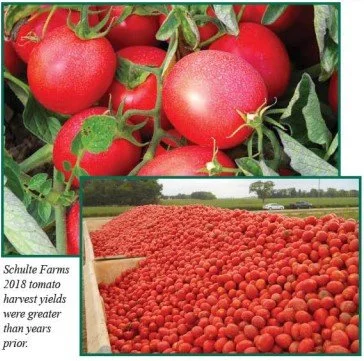
Finally the season was winding down and it was time to harvest. Since the tomatoes are harvested on a contract schedule, the fields are scouted and then sprayed with a ripening agent so as to be ready on time of harvest. When scouting the fields, they noticed there were quite a bit more tomatoes than usual even though the foliage never got as big as before. With the color not as red as they liked them to be, they sprayed the ripening agent to be ready for the scheduled time. When the harvest got underway, most of the fields yielded 42 tons and the better fields yielded as high as 55 to 60 tons of tomatoes to the acre. In other good years, a crop yielded around 32 tons. Something else that was noticed: The tomatoes were much more consistent in their color which ended up giving them a high quality percentage than ever before. When arriving at the processing plant, the tomato loads are graded by slicing off the tops of the selected tomatoes on the load and inspected for what is called yellow shoulder, a yellowing color in the tomato. If it's there in the ones inspected, the load then goes to ketchup processing. If the color is consistently red, they go for peeler grade.
Even though they're extremely happy with the results this year, you can see it wasn't a walk in the park. Their skepticism for now has worn off, and I think it sounds like they believe they're on the right track to their success. Every year in farming is different and there will be more challenges down the road, but I believe having the Growers Program in your toolbox of farming methods will go a long way toward helping the farmers reach their goals for success.
Thanks to Schulte Farms for their patience and persistent efforts in working with all of us involved. Thanks also to Alton, Bruce Stephens, and Matt Gooding for their efforts. May this be a long and prosperous business relationship.
This is an excerpt from the Winter Growers Solution (2019) written by Mike Bulcher.
Signup for our newsletter to stay in the loop
